Realistic Lifesaving Lessons
Lifesaving is a valuable community skill for everyone and more fun than swimming up and down.
However, too many lifesaving clubs focus on competitions or passing exams rather than training for real life survival. The pool water is warm and clear, no wind, no waves, no sunburn, everyone just in swimwear. Life is easy!
The Real World is Different
The weather can be hot or cold or windy. You will come across currents, waves, murky water, and obstacles. Casualties may not behave they way they did in the text book or in pool training.
In case of emergency, you will have no time to change into your swimming costume. You may have to go into the water fully clothed to escape from danger or to help a casualty. Are you prepared for that? Did you bring your flippers and floats?
Most lifesaving classes don't prepare you for a real situation. They are run like swimming clubs, using flippers and swimsuits rather than realistic kit. We intend to change this by bringing you training materials that help you run a realistic lifesaving and survival swimming class.
Integrate Lifesaving into Aquatic Sports
Teaching lifesaving as a separate skill is outdated. It needs to become an integrated part of all aquatic sports. Frequent training makes your rescue skills nearly automatic so that any emergency response becomes almost routine.
Today most people are looking for fun, or extreme sports, where they can explore their limits. Lifesaving and survival swimming can offer this in a safe environment. Lifeguard techniques are easy to master, even teenagers can handle them.
Lifeguard Qualifications
Lifeguard qualifications are awarded by the national organisations in your country, not by the Free Lifesaving Society. This is necessary for you to get a lifeguard job in your area. We encourage you to work closely with local teams and national organisations in your country. Lifesaving is a team effort. Together we can make a difference.
Minimum ability test before joining a lifesaving course:
- Jump/dive into deep water.
- Swim 50 metres in less than 60 seconds.
- Swim 100 metres continuously on front and back.
- In deep water, tread water for 30 seconds.
- Surface dive to the floor of the pool.
- Climb out unaided without a ladder or steps and where the pool design permits.
Teaching the Teachers
Until we have members in each region we aim to teach the teachers via the web or our team members, where available. The resources on this website are free to use by everyone for their survival swimming and lifesaving classes.
When required we coach individual teachers or groups, assisting with their specific requirements and advising on relevant matters.
We hope we can help you run water safety and lifesaving classes in your area with the material we provide free of charge.
Feel free to contact us with any requests you may have.
Buddy System
Two teachers are better than one. One teacher explains a certain skill to the class while the other goes into the water and demonstrates it.
Always teach in a lifeguarded area. While teachers focus on their lesson, someone else should keep a look out.

Student and teacher enter the water for training.
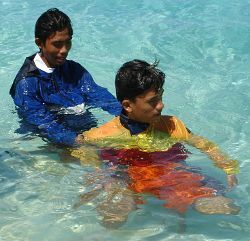
Student practices a skill that was shown earlier.
Tell - Show - Try - Do
Students learn a lot more if you tell and show them so they can try it first and then do it too.
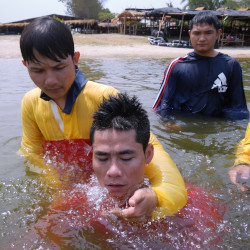
Lifesaving teacher shows skills.
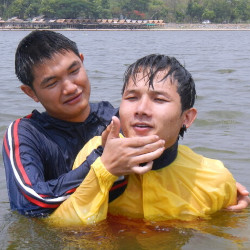
Students try them out.
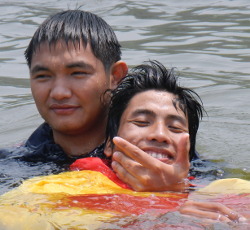
Soon they can do it no matter what the situation is or where they are.
Required Equipment
For an efficient lifesaving course you need a bit of kit:
- Course Materials and Equipment
- Reaching poles and ropes
- Rescue tubes or torpedo bouy
- Floating containers or bottles
- CPR manikin
- First aid kit
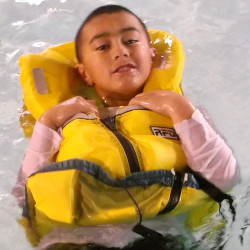
Lifejackets must fit well, not be too large or small.

Ropes, poles, and canisters are useful for initiative tests.
Clothing
Lifesaving is a close contact sport. For realism and to respect other's modesty, swimmers wear proper clothing during all pool training sessions. It is important to note that all clothes should fit properly and be comfortable for the participant to wear while swimming and performing exercises on poolside or in the water.
Sportswear
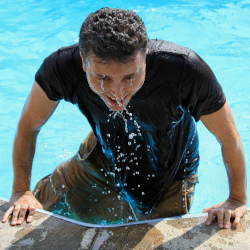 For the basic swimming exercises,
we wear light clothing
and athletic shoes that can be worn in the water.
Socks avoid chafing.
Regular Clothing
 Realistic lifesaving lessons are done fully clothed:
jeans,
hoodies,
tracksuits,
anoraks,
ponchos,
and overalls.
Clothes made of synthetic materials, like anoraks and nylon pants, soak up less water and dry faster. This makes them ideal for lifesaving practice and survival swimming. Cotton clothes become quite heavy and difficult to move in when wet. Some swimmers may see this as an interesting fun challenge.

Resistance swim training
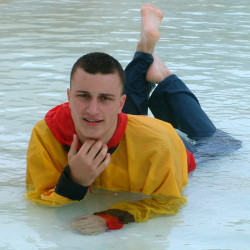
Lifesaving practice clothes

Heavy wet cotton is a challenge